Light-emitting diode (LED) is a widely used standard source of light in electrical equipment. It has a wide range of applications ranging from your mobile phone to large advertising billboards. They mostly find applications in devices that show the time and display different types of data.
What is LED?
A light-emitting diode (LED) is a semiconductor device that emits light when an electric current flows through it. When current passes through an LED, the electrons recombine with holes emitting light in the process. LEDs allow the current to flow in the forward direction and blocks the current in the reverse direction.
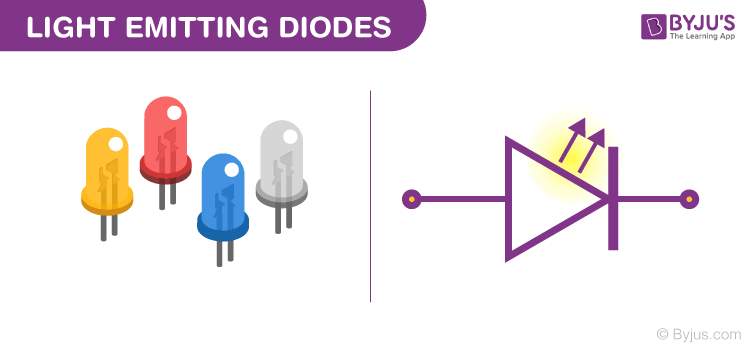
Light-emitting diodes are heavily doped p-n junctions. Based on the semiconductor material used and the amount of doping, an LED will emit coloured light at a particular spectral wavelength when forward biased. As shown in the figure, an LED is encapsulated with a transparent cover so that emitted light can come out.
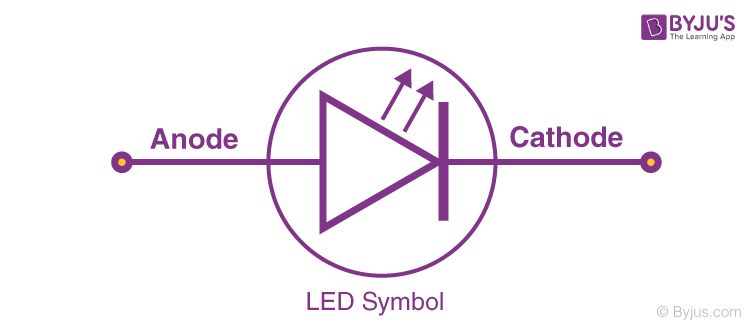
LED Symbol
The LED symbol is the standard symbol for a diode, with the addition of two small arrows denoting the emission of light.
Simple LED Circuit
The figure below shows a simple LED circuit.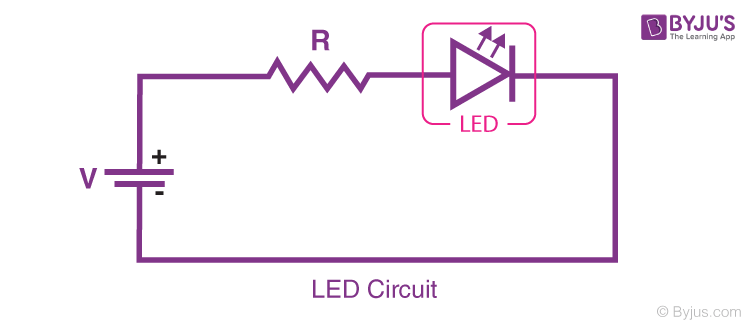
The circuit consists of an LED, a voltage supply and a resistor to regulate the current and voltage.
How does an LED work?
When the diode is forward biased, the minority electrons are sent from p → n while the minority holes are sent from n → p. At the junction boundary, the concentration of minority carriers increases. The excess minority carriers at the junction recombine with the majority charges carriers.
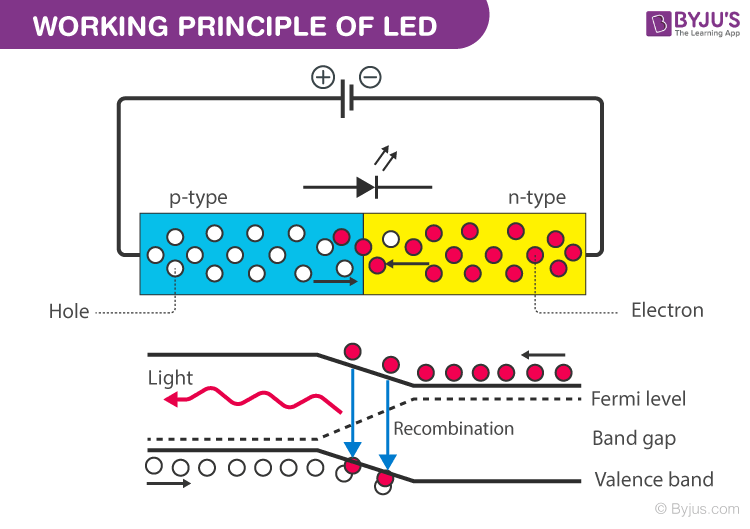
The energy is released in the form of photons on recombination. In standard diodes, the energy is released in the form of heat. But in light-emitting diodes, the energy is released in the form of photons. We call this phenomenon electroluminescence. Electroluminescence is an optical phenomenon, and electrical phenomenon where a material emits light in response to an electric current passed through it. As the forward voltage increases, the intensity of the light increases and reaches a maximum.
What determines the colour of an LED?
The colour of an LED is determined by the material used in the semiconducting element. The two primary materials used in LEDs are aluminium gallium indium phosphide alloys and indium gallium nitride alloys. Aluminium alloys are used to obtain red, orange and yellow light, and indium alloys are used to get green, blue and white light. Slight changes in the composition of these alloys change the colour of the emitted light.
Properties of Laser Light
Laser light is monochromatic, directional and coherent.
Laser Light is Monochromatic
Unlike white light, which is made of seven colours, laser light is made of a single colour.
Laser Light is Directional
Laser light is highly directional.
Laser Light is Coherent
Laser light is coherent because the wavelengths of the laser light are in phase in space and time.
Uses of LED
LEDs find applications in various fields, including optical communication, alarm and security systems, remote-controlled operations, robotics, etc. It finds usage in many areas because of its long-lasting capability, low power requirements, swift response time, and fast switching capabilities. Below are a few standards LED uses:
- Used for TV back-lighting
- Used in displays
- Used in Automotives
- LEDs used in the dimming of lights
Types of LED
Below is the list of different types of LED that are designed using semiconductors:
- Miniature LEDs
- High-Power LEDs
- Flash LED
- Bi and Tri-Colour
- Red Green Blue LEDs
- Alphanumeric LED
- Lighting LED
Advantages of LEDs over Incandescent Power Lamps
Some advantages of LEDs over Incandescent Power Lamps are:
- LEDs consume less power, and they require low operational voltage.
- No warm-up time is needed for LEDs.
- The emitted light is monochromatic.
- They exhibit long life and ruggedness.
Frequently Asked Questions – FAQs
Q1 What is LED?
A light-emitting diode (LED) is a semiconductor device that emits light when an electric current flows through it.
Q2 What is Light Emitting Diodes used for?
LEDs have a wide range of applications ranging from your mobile phone to large advertising billboards. They mostly find applications in devices that show the time and display different types of data.
Q3 How do LEDs work?
LEDs work on the principle of Electroluminescence. On passing a current through the diode, minority charge carriers and majority charge carriers recombine at the junction. On recombination, energy is released in the form of photons. As the forward voltage increases, the intensity of the light increases and reaches a maximum.
Q4 What is Electroluminescence?
Electroluminescence is an optical phenomenon, and electrical phenomenon where a material emits light in response to an electric current passed through it.
Q5 What are the advantages of LEDs?
LEDs consume less power, and they require low operational voltage. No warm-up time is needed for LEDs.
Stay with HEMBO-NOVA and contact to find the sincerest service!
